

In this guide
- What is a self-driving car?
- The six levels of driving automation
- Sensors: how the car sees
- The software stack: how the car thinks
- The maths and programming behind it
- Use cases and benefits
- Challenges still being solved
- Careers in autonomous vehicles
- How to get started
- Training – Self Driving Cars (Udacity)
1. What Is a Self-Driving Car?
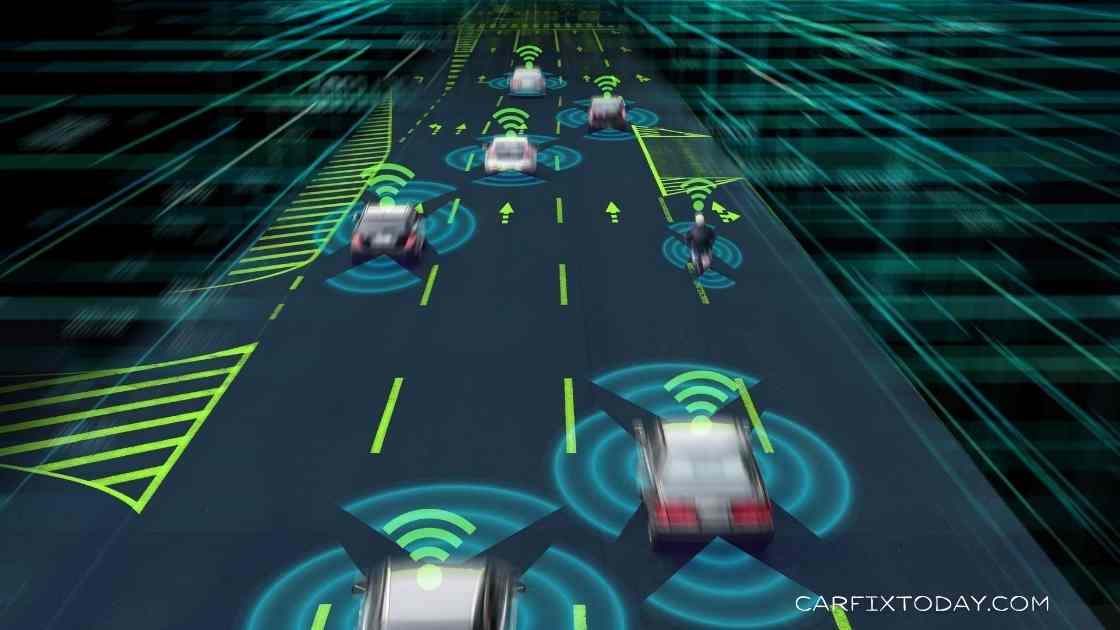
According to Car and Driver, a self-driving car is a vehicle that can operate without a human driver. It relies on advanced sensing technologies, such as lidar, sonar, GPS, radar, odometry, and inertial measurements, to detect changes in its surroundings and adjust its speed and position to stay safe.
A self-driving car, also called an autonomous vehicle (AV), performs the same three tasks a human driver does, but with machines: it senses the world around it, decides what to do, and acts by steering, accelerating, and braking. What makes this so difficult is that roads are unpredictable. Pedestrians step out, other drivers make mistakes, weather changes, and road works appear without warning. A self-driving system must handle all of this safely, every time.
Today, fully driverless robotaxi services operate in a limited number of cities, while most new consumer cars offer partial automation such as adaptive cruise control and lane-keeping assistance. The field sits at the meeting point of robotics, artificial intelligence, and automotive engineering.
2. The Six Levels of Driving Automation
The industry uses a scale defined by SAE International, running from Level 0 to Level 5. The key dividing line is between Level 2 and Level 3: below it, a human must supervise at all times; above it, the system itself is responsible for driving under certain conditions.
| Level | Name | Who is driving? | Example |
|---|---|---|---|
| 0 | No automation | The human, with at most warnings | Blind-spot or collision warnings |
| 1 | Driver assistance | The human, with help on steering or speed | Adaptive cruise control |
| 2 | Partial automation | The human must supervise constantly; the system steers and controls speed | Combined lane-centring and adaptive cruise |
| 3 | Conditional automation | The system, in specific conditions; the human must take over when asked | Traffic-jam pilots on approved motorways |
| 4 | High automation | The system, within a defined area or conditions; no human needed | Driverless robotaxis in mapped city zones |
| 5 | Full automation | The system, everywhere and in all conditions | Not yet available |
3. Sensors: How the Car Sees
No single sensor is good at everything, so self-driving cars combine several. Merging their information into one reliable picture is called sensor fusion.
| Sensor | How it works | Strengths | Limitations |
|---|---|---|---|
| Cameras | Capture images like human eyes | Read signs, lane lines, and traffic lights; low cost | Struggle in glare, darkness, and heavy rain |
| Lidar | Fires laser pulses and measures their return to build a 3D map | Precise distance and shape | Higher cost; affected by fog and snow |
| Radar | Uses radio waves to detect objects and their speed | Works well in bad weather; measures speed directly | Lower detail than lidar or cameras |
| Ultrasonic (sonar) | Uses sound waves at short range | Cheap and reliable for parking | Only a few metres of range |
| GPS and IMU | Satellite positioning plus motion sensors (inertial measurement) | Global position, acceleration, and rotation | GPS alone is not precise enough for lane-level driving |
| Odometry | Measures wheel rotation to estimate distance travelled | Continuous, short-term motion tracking | Small errors build up over time |
4. The Software Stack: How the Car Thinks
Behind the sensors is a chain of software modules that turn raw data into driving decisions many times per second.
- Perception. Identifies what is around the car: vehicles, pedestrians, cyclists, lane markings, signs, and traffic lights. This relies heavily on computer vision and machine learning.
- Localisation. Works out exactly where the car is, often to within a few centimetres, by comparing sensor data against detailed high-definition maps.
- Prediction. Estimates what other road users are likely to do next, such as whether a pedestrian will cross or a car will change lanes.
- Planning. Chooses the route, the driving behaviour (overtake, wait, merge), and a safe, smooth path for the next few seconds.
- Control. Converts the planned path into precise steering, throttle, and brake commands.
Simulation matters too: before software reaches public roads, it is tested across millions of simulated kilometres, including rare and dangerous scenarios that would be unsafe to recreate in real life.
5. The Maths and Programming Behind It
Self-driving technology draws on several technical disciplines:
- Python: widely used for prototyping, data analysis, and machine learning.
- C++: used in production vehicle software, where speed and reliability are critical.
- Linear algebra: matrices describe positions, rotations, and transformations between sensor viewpoints.
- Calculus: models motion, speed, and acceleration.
- Probability: handles uncertainty, because no sensor reading is ever perfectly accurate.
- Computer vision and machine learning: allow the car to recognise objects and learn from large amounts of driving data.
Here is a small taste of how probability is used. A Kalman filter combines an uncertain estimate with a new sensor reading to produce a better estimate. In this example, the car believes it is at 10 metres (with high uncertainty), and a sensor reports 12 metres (with lower uncertainty):
def update(mean1, var1, mean2, var2):
    new_mean = (var2 * mean1 + var1 * mean2) / (var1 + var2)
    new_var = 1 / (1 / var1 + 1 / var2)
    return new_mean, new_var

# belief: 10 m (variance 4), sensor: 12 m (variance 1)
print(update(10, 4, 12, 1))   # (11.6, 0.8)
The result, 11.6 metres, sits closer to the more trustworthy sensor, and the new variance of 0.8 is lower than either input. In other words, combining information makes the car more certain than any single source could.
6. Use Cases and Benefits
Autonomous driving technology is being applied well beyond passenger cars:
| Application | How autonomy is used |
|---|---|
| Driver assistance (ADAS) | Lane keeping, adaptive cruise, automatic emergency braking, and parking assistance in everyday cars |
| Robotaxis | Driverless ride-hailing within defined city areas |
| Trucking and logistics | Long-distance freight on motorways, where routes are predictable |
| Last-mile delivery | Small autonomous vehicles and robots delivering parcels and food |
| Mining, agriculture, and ports | Autonomous haul trucks, tractors, and container movers in controlled sites |
| Public transport | Autonomous shuttles on fixed routes such as campuses and airports |
Potential benefits
- Road safety. Human error, including distraction, fatigue, and impairment, plays a role in a large share of crashes. Well-designed automated systems do not get tired or distracted.
- Mobility and independence. Older people and those unable to drive could travel more freely.
- Efficiency. Smoother driving can reduce fuel or energy use and ease congestion.
- Productivity. Travel time could be used for work or rest.
- Business operations. Logistics, mining, and agriculture can run longer hours with more consistent performance.
7. Challenges Still Being Solved
Despite major progress, full autonomy everywhere remains a hard problem. The main obstacles include:
- Rare situations (“edge cases”). Unusual events such as a police officer directing traffic by hand or debris on the road are difficult to anticipate.
- Weather and visibility. Snow, heavy rain, and fog degrade sensor performance.
- Regulation and liability. Laws on testing, deployment, and responsibility after a crash differ between countries and are still developing.
- Cost. Sensors and computing hardware remain expensive at scale.
- Public trust and cybersecurity. People need confidence that systems are safe and protected from tampering.
8. Careers in Autonomous Vehicles
Self-driving technology employs specialists across many disciplines. The same skills also transfer to robotics, drones, industrial automation, and driver-assistance work at car manufacturers and their suppliers.
| Role | Focus | Key skills |
|---|---|---|
| Perception Engineer | Detecting and classifying objects from sensor data | Computer vision, deep learning, Python, C++ |
| Localisation & Mapping Engineer | Pinpointing the vehicle’s position and building HD maps | Probability, sensor fusion, geometry |
| Motion Planning Engineer | Deciding the vehicle’s behaviour and path | Algorithms, optimisation, C++ |
| Controls Engineer | Translating plans into steering and braking commands | Control theory, vehicle dynamics, calculus |
| Simulation & Test Engineer | Building virtual worlds and test scenarios | Programming, 3D tools, test design |
| Safety Engineer | Proving the system meets safety standards | Functional safety standards, risk analysis |
| Embedded / Systems Engineer | Running software reliably on vehicle hardware | C++, real-time systems, hardware integration |
What the career path looks like
Many engineers enter the field with a degree in computer science, electrical, mechanical, or robotics engineering, although strong project portfolios and specialised courses also open doors. Early roles usually focus on one module of the stack, such as perception or testing. With experience, engineers either deepen their specialism, move into system-level architecture, or lead teams. Because this is a research-heavy field, continuous learning is part of the job.
Pay and hiring levels vary by country and change with investment in the industry. Check current job listings in your region for an accurate picture.
9. How to Get Started
- Build solid Python skills. Python is the most common entry point for prototyping and machine learning.
- Refresh your maths. Focus on linear algebra, basic calculus, and probability.
- Learn the basics of C++. It is the standard language for performance-critical vehicle software.
- Explore computer vision. Start with simple projects such as detecting lane lines in road images.
- Experiment with simulators and robotics tools. Open-source driving simulators and the Robot Operating System (ROS) let you practise without a real vehicle.
New to programming? Start with our guide to Training – Introduction To Programming to build the Python foundation this field requires.
10. Training – Self Driving Cars (Udacity)
This program builds the foundations needed for autonomous vehicle engineering. You sharpen your Python skills, apply C++, use matrices and calculus in code, and get an introduction to computer vision and machine learning. Throughout, these concepts are applied to real self-driving car problems rather than abstract exercises.
By the end, you will be prepared for more advanced study, including Udacity’s Self-Driving Car Engineer Nanodegree program.
Recommended Trainings
- Training – Introduction To Programming
- Training – Android Basics By Google
- Training – Business Analytics
- Training – Digital Freelancer
Note: Course content, duration, and pricing are set by the training provider and may change. Autonomous vehicle regulations and deployments vary by country and are evolving quickly.


2 comments
Did you know that the field of autonomous vehicles is set to grow by 42% within the next four years?
Or that salaries for top engineers average between $300k-$500k?
If you’d like to get the in-demand skills you need to advance in this lucrative field, check out our part-time, online Autonomous Systems Nanodegree programs where you’ll:
1 Learn from the world’s foremost robotics experts
2 Explore self-driving cars with Sebastian Thrun, founder of Google’s self-driving car team, sensor fusion built in collaboration with Mercedes-Benz, and learn robotics from industry leaders like NVIDIA
3 Complete industry-designed projects that showcase your skills to employers
4 Tackle real-world projects such as building a route planner, detecting obstacles in lidar, finding lane lines on the road, and filtering data from an array of sensors
5 Learn key techniques that world-class companies are recruiting for, including C++, Robotics, Object Oriented Programming, Computer Vision, Machine Learning, Deep Learning, Sensor Fusion, and 3D Motion Planning
6 Use CloudFormation, Ansible, Kibana, Grafana, AWS, Microsoft Azure, Nutanix, and Kubernetes
Putting in just 10-15 hours a week for as few as three months, you can learn the skills you need to help advance your tech career and increase your earning potential.
[…] year resolution is intended for here. You need to think about additional learning such as robotics, self driving cars, programming languages, reading a new book, learning to blog, launching a new website and so on. […]