
AI and Children – 5 Critical Risk Areas To Address
Table of Contents
Introduction
Artificial Intelligence is rapidly becoming part of childhood. Unlike previous technological revolutions, AI is not limited to specialists or professionals. It is available to almost anyone with a smartphone, often at little or no cost. Children can use AI to ask questions, generate content, solve problems, write code, create images, and seek advice at any time of day.
The benefits of AI are widely recognized and extensively discussed. This article deliberately focuses on another side of the conversation: the risks that AI presents to children and teenagers, and the collective responsibility required to reduce those risks.
The purpose is not to create fear of AI. Nor is it to discourage innovation. Instead, it is to encourage thoughtful action before isolated incidents become widespread societal problems.
Every new technology has introduced new risks. Automobiles led to seatbelts and traffic laws. Medicines require child-resistant packaging. The internet led to parental controls, online safety education, and cybersecurity measures. How AI Is Revolutionizing Education: An 8 Points Useful Parent’s Guide | AllGoodSchools
Artificial Intelligence deserves the same level of attention.
The AI Safety Gap
Today’s children are often more familiar with AI tools than their parents.
Many parents are still learning what conversational AI is, while their children are already experimenting with multiple AI applications. This creates an unprecedented situation in which the technology evolves faster than the ability of many families to understand it.
This challenge is particularly significant in regions where digital literacy remains limited. Millions of parents may own smartphones yet have little understanding of AI systems, their capabilities, or their potential risks.
Expecting every parent to keep pace with rapid AI developments is unrealistic.
Parents remain essential, but they should not become the only safeguard standing between children and emerging technological risks.
Protecting children in the age of AI requires a layered approach involving families, educators, AI developers, technology companies, governments, researchers, and society as a whole.

Five Critical Risk Areas Requiring Immediate Attention
1. Privacy Risks
Children may unknowingly share personal information, family details, school information, passwords, photographs, financial information, or sensitive documents with AI systems.
Potential consequences include:
- Loss of privacy
- Identity theft
- Digital profiling
- Permanent online exposure
- Future reputational harm
Shared Responsibilities
Parents
- Discuss what information should never be shared with AI.
- Keep communication open so children feel comfortable reporting mistakes.
Schools
- Include AI privacy awareness in digital citizenship programs.
- Teach students how personal data can be collected and used.
AI Developers
- Minimize/eliminate unnecessary data collection.
- Detect and discourage the sharing of sensitive personal information.
- Build child-friendly privacy defaults.
Governments
- Enforce strong child data protection laws.
- Require transparency regarding data storage and usage.
Technology Platforms
- Offer robust parental supervision tools.
- Make privacy settings easy to understand and configure.
2. Psychological Risks
Children may begin relying on AI for emotional support, validation, advice, or companionship. They may also struggle to distinguish between machine-generated responses and genuine human understanding.
Potential consequences include:
- Emotional dependency
- Social isolation
- Reduced resilience
- Distorted expectations of relationships
Shared Responsibilities
Parents
- Maintain meaningful conversations and encourage healthy human relationships.
Schools
- Teach emotional intelligence alongside digital literacy.
AI Developers
- Clearly communicate that AI is not a substitute for trusted adults or mental health professionals.
- Design systems that encourage users to seek appropriate human support when needed.
Governments
- Develop age-appropriate standards for AI interactions with minors.
Healthcare Professionals
- Study the long-term psychological effects of AI on child development and inform public guidance.
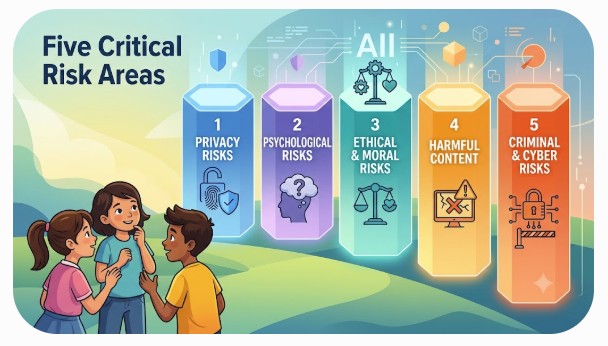
3. Ethical and Moral Risks
AI can make it easier to cheat on assignments, plagiarize work, manipulate images, impersonate others, or justify unethical behavior.
The concern extends beyond academic integrity. It is about the gradual development of personal values and decision-making.
Shared Responsibilities
Parents
- Emphasize honesty, accountability, and responsible technology use.
Schools
- Update academic integrity policies to reflect AI-assisted learning.
- Teach students when AI assistance is appropriate and when it is not.
AI Developers
- Reduce opportunities for misuse while preserving legitimate educational uses.
- Provide clear guidance on responsible use.
Governments
- Support national AI literacy initiatives and ethical education.
Society
- Reinforce the message that technology should amplify integrity rather than replace it.
4. Exposure to Harmful Content
Children may attempt to use AI to locate or gain access to pornography, violent material, dangerous challenges, extremist content, or age-inappropriate information. Even when AI systems refuse such requests, determined users may try alternative prompts or use AI to discover pathways to harmful material elsewhere.
Potential consequences include:
- Early exposure to explicit material
- Normalization of harmful behaviors
- Desensitization to violence
- Increased vulnerability to manipulation
Shared Responsibilities
Parents
- Understand which AI applications children use.
- Use available parental controls where appropriate.
- Create an environment where difficult conversations are possible.
Schools
- Teach digital resilience and critical thinking.
AI Developers
- Continuously improve safeguards against age-inappropriate interactions.
- Invest in stronger detection of harmful prompting patterns.
Governments
- Establish child safety standards for AI services accessible to minors.
App Stores and Device Manufacturers
- Strengthen age ratings, parental controls, and content management tools.

5. Criminal and Cybersecurity Risks
A small minority of children may attempt to misuse AI for harmful purposes such as online fraud, phishing, impersonation, harassment, or other unlawful activities. More commonly, children themselves may become targets of scams, manipulation, or cybercrime facilitated by AI. 100 Cybersecurity Tips For Young Teens – Don’t Take Risk | AllGoodSchools
The vast majority of children will never engage in such behavior. However, effective safety systems are designed with rare but serious risks in mind.
Shared Responsibilities
Parents
- Encourage openness if children encounter suspicious online situations.
Schools
- Include cybersecurity awareness as part of everyday education.
AI Developers
- Continue strengthening safeguards that discourage misuse and identify abuse patterns while respecting privacy and legitimate use.
Governments and Law Enforcement
- Update legislation and investigative capabilities to address AI-enabled harms involving minors.
Technology Companies
- Provide effective reporting mechanisms and collaborate responsibly on child safety initiatives.

The Principle of Shared Responsibility
The central question should not be:
“Who is responsible for protecting children from AI?”
The better question is:
“How can every stakeholder contribute to reducing risk?”
- Parents provide guidance.
- Schools provide education.
- AI developers design safer systems.
- Technology companies provide protective tools.
- Governments establish standards and accountability.
- Researchers study emerging risks.
- Healthcare professionals monitor developmental impacts.
- Communities promote awareness.
Each layer reduces risk. None can eliminate it alone.
The Dark Side of AI: Risks to Children – Child Rescue Coalition
Role of AI Companies in Protecting Children (Safety-by-Design Principles)
1. Intent-Aware Refusal Systems (Not Keyword Blocking)
- Detect meaning and intent, not just specific words
- Identify risky goals even when phrased indirectly
- Distinguish curiosity from harmful intent
- Respond differently to accidental vs deliberate misuse
2. Child-Mode Reasoning Layer (Value-Driven Responses)
- Adapt explanations to developmental age and understanding
- Use simple, non-technical language
- Reinforce positive values (safety, respect, honesty, empathy)
- Avoid exposing advanced or abstract technical pathways
3. Safe Redirection Instead of Dead-End Refusal
- Do not only say “no” or “I can’t help”
- Redirect toward safe alternatives or educational context
- Turn risky intent into learning opportunities
- Guide behavior rather than just blocking output
4. Repeated-Risk Detection (Behavior Pattern Awareness)
- Track patterns of repeated unsafe requests over time
- Detect escalation (curiosity → experimentation → intent)
- Apply stronger safeguards as risk increases
- Recognize persistence even when prompts are reworded
5. Built-In Moral Constraint Frameworks for Minors
- Apply child-specific ethical boundaries by default
- Reinforce harm prevention and respect for others
- Embed safety rules that cannot be easily bypassed by phrasing tricks
- Prioritize well-being over capability or completeness of answers
6. No Exposure to Sensitive Capability Pathways (Even Indirectly)
- Avoid teaching “how to do harmful things,” even in partial form
- Do not reveal step-by-step pathways that could be misused
- Prevent indirect learning of unsafe methods through explanation
- Design responses so they do not become reusable instruction manuals for harm
Conclusion
Artificial Intelligence is advancing faster than any previous consumer technology. While innovation continues at remarkable speed, our systems for protecting children must evolve just as quickly.
Parents should not be expected to become AI engineers before they can safeguard their families. At the same time, technology companies cannot replace parental involvement, and governments cannot legislate away every risk.
Protecting children in the AI era requires shared responsibility, continuous learning, and a commitment to designing safety into technology rather than expecting families to bear the entire burden.
The success of AI should not be measured solely by its capabilities, but also by its ability to coexist safely with the curiosity, vulnerability, and developing judgment of the next generation.