
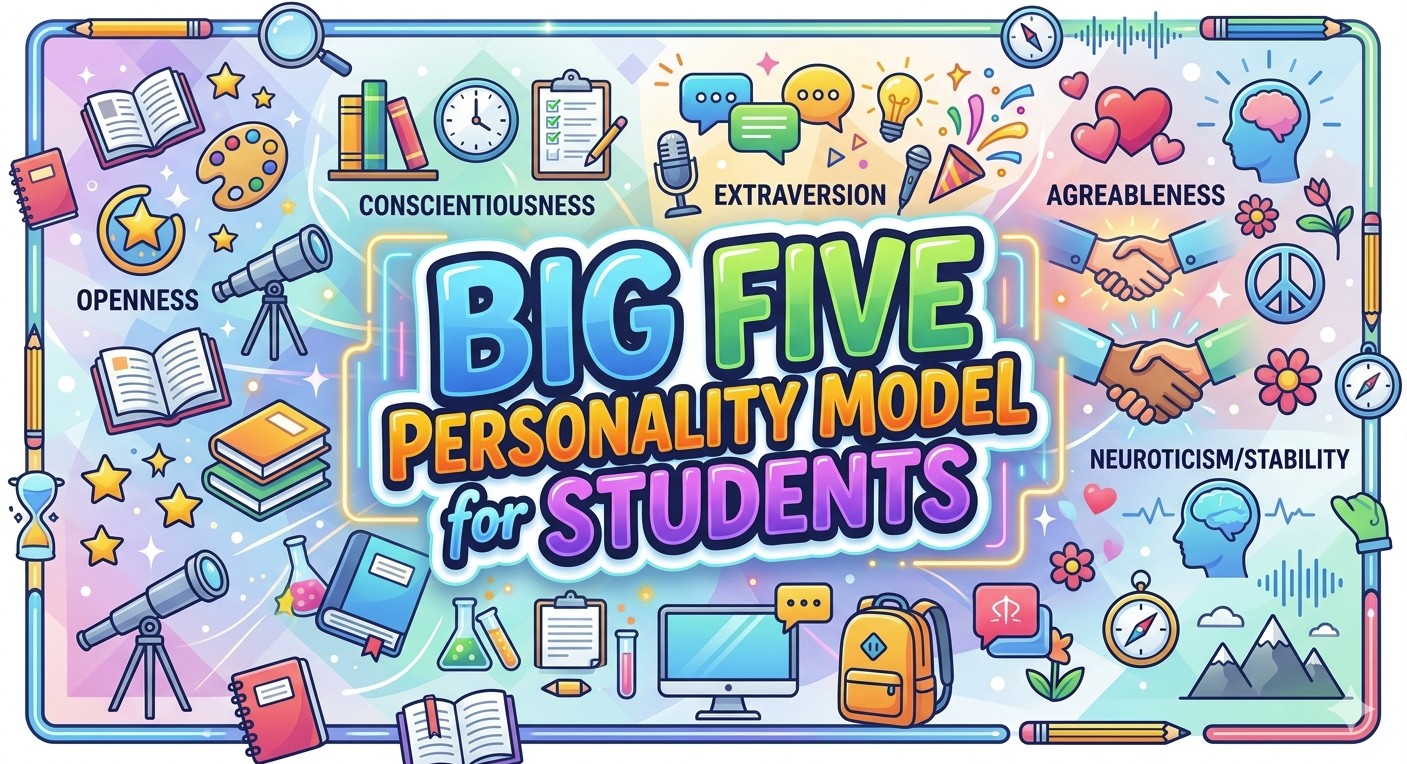
Understanding the Big Five Personality Model: A Guide for Students
Have you ever wondered why some students love group discussions while others prefer quiet reading corners? Why some people plan every detail while others go with the flow? The answer may lie in a fascinating psychological theory called the Big Five Personality Model for Students.
Understanding this model can help students discover their strengths, improve relationships, and make smarter academic and career decisions. Let’s break it down in a simple, student-friendly way.
Table of Contents
What Is the Big Five Personality Model For Students?
The Big Five Personality Model, also known as OCEAN, is a widely researched framework used to describe human personality. It includes five broad traits that shape how we think, feel, and behave:
- Openness to Experience
- Conscientiousness
- Extraversion
- Agreeableness
- Neuroticism
Each person falls somewhere on a spectrum for each trait — there’s no “good” or “bad,” just different personalities!
1. Openness to Experience – “The Curious Explorer”
What it means:
- High: You love creativity, imagination, trying new things, and exploring ideas.
- Low: You prefer routines, familiar environments, and practical solutions.
For Students:
- High-openness students may enjoy art, creative writing, science experiments, and debating big ideas.
- Lower-openness students may do better with structured learning and clear step-by-step instructions.

2. Conscientiousness – “The Organizer”
What it means:
- High: You’re responsible, goal-oriented, and self-disciplined.
- Low: You may be spontaneous, flexible, or sometimes forgetful with tasks.
For Students:
- High-conscientiousness students are the planners, note-takers, and early submitters.
- If this is a weaker area for you, try using to-do lists or digital planners to stay on track.
3. Extraversion – “The Social Butterfly”
What it means:
- High: You love being around people, talking, and participating in group activities.
- Low (introversion): You prefer quiet spaces, solo tasks, and deep thinking.
For Students:
- Extroverts shine in presentations, leadership roles, and team projects.
- Introverts may excel in writing, analysis, and one-on-one discussions.
Tip: Schools need both personalities. Find your comfort zone but also challenge yourself to grow.
4. Agreeableness – “The Kind Helper”
What it means:
- High: You are cooperative, empathetic, and kind-hearted.
- Low: You may be more competitive, critical, or straightforward.
For Students:
- High-agreeable students are great at group work, peer support, and resolving conflicts.
- Lower-agreeable students may be strong debaters or natural leaders, especially when guided with empathy.
5. Neuroticism – “The Emotional Reactor”
What it means:
- High: You may experience emotions like anxiety, worry, or frustration more intensely.
- Low: You are generally calm, stable, and resilient under pressure.
For Students:
- If you score high in neuroticism, you might feel nervous before tests or get stressed easily.
- Practicing mindfulness, breathing exercises, and time management can help you manage emotions better.
Why Should Students Learn About the Big Five?
Understanding your personality helps you:
- Discover how you learn best
- Improve friendships and teamwork
- Choose subjects, hobbies, and careers that suit you
- Build emotional intelligence and self-awareness
It also helps teachers and parents understand how to support you effectively in your education journey.
How to Find Out Your Personality Type?
You can take a free Big Five test online from trusted sources like:
Answer honestly and reflect on your results — it’s not a judgment, but a tool for growth!
Final Thoughts: Be Proud of Who You Are
There’s no perfect personality. Whether you’re a quiet artist or a loud leader, your unique combination of traits makes you special.
The goal isn’t to change who you are. It’s to understand yourself, improve where needed, and become the best version of YOU.
Let your personality guide you, not limit you — and remember, even small changes in mindset can lead to big transformations.
Some Recomended Articles;
- 80 Types Of Students – Which One Are You?
- Comparison Of Convergent And Divergent Students
- 50 Useful Ideas For Teaching Business To Kids
Summary Table: Big Five Traits for Students
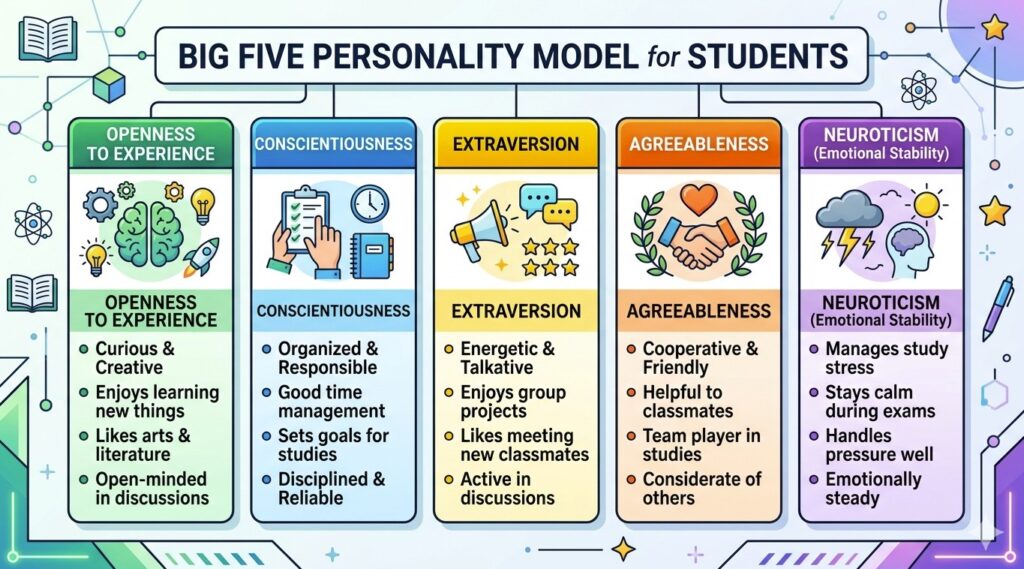
| Trait | Description | Student Strengths |
|---|---|---|
| Openness | Imaginative, creative | Art, literature, science exploration |
| Conscientiousness | Organized, responsible | Time management, project planning |
| Extraversion | Outgoing, energetic | Group work, presentations |
| Agreeableness | Kind, cooperative | Teamwork, peer relationships |
| Neuroticism | Emotionally reactive | Self-reflection, emotional awareness |
📚 Attribution: The Big Five personality model (also known as the Five-Factor Model) was developed through the work of researchers including Paul Costa, Robert McCrae, and Lewis Goldberg. This article provides an educational overview and practical application for students