
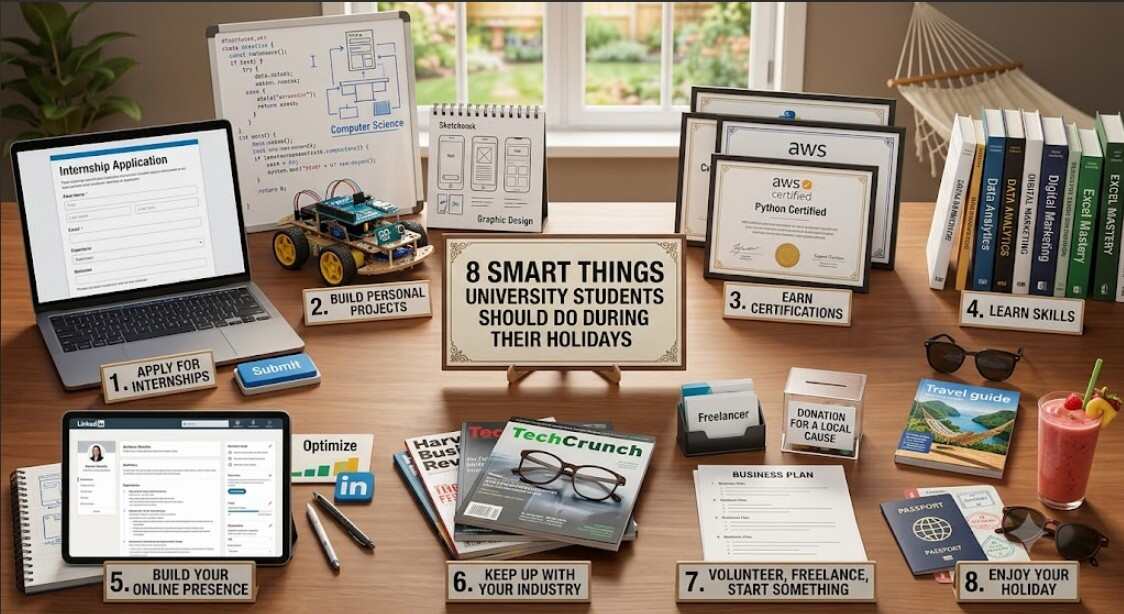
8 Smart Things University Students Should Do During Their Holidays
For most university students, holidays feel like a reward. After months of lectures, assignments, exams, and deadlines, it’s finally time to relax. And honestly, you should. Getting enough rest is important.
But here’s the thing. University holidays are also one of the biggest opportunities you’ll get all year.
Think about it. During the semester, you’re busy juggling classes, studying, group projects, and maybe even a part time job. Your free time disappears quickly. Holidays give you something that’s much harder to find during the academic year, uninterrupted time.
You don’t need to spend every day working. In fact, you shouldn’t. But if you can dedicate even an hour or two a day to improving yourself, by the time the next semester starts you’ll be in a much better position than you were before.
Whether your goal is landing an internship, building your resume, learning new skills, or simply figuring out what career you want, your holiday is the perfect time to start.
Table of Contents
1. Apply for Internships, even if You Think You’re Not Qualified
If there’s one thing you should seriously consider during your university break, it’s applying for internships.
Many students make the mistake of waiting until their final year because they assume companies won’t hire someone with little experience. That’s not always true. Plenty of companies offer internships for first and second year students because they’re looking for people who are eager to learn, not experts.
An internship helps you understand what working in your field is actually like. You’ll experience deadlines, meetings, teamwork, and real projects that simply can’t be recreated in a classroom. It also helps you decide whether you’re actually interested in that career before graduating.
Don’t be discouraged if you don’t hear back immediately. It’s completely normal to apply to dozens of internships before receiving an interview. This article is about 8 Smart Things University Students should do.
Where to look for internships
Instead of relying on one website, check multiple platforms regularly.
- LinkedIn Jobs
- Indeed
- Glassdoor
- Handshake
- Your university’s career portal
- Company career pages
- Government internship programs in your country
A lot of companies also post internships directly on their social media pages before listing them anywhere else.

Tips that can improve your chances
Before sending applications, spend some time preparing.
- Keep your resume to one page.
- Create a professional LinkedIn profile.
- Customize your CV for different roles.
- Write a short but personalized cover letter.
- Connect with recruiters and professionals in your industry.
- Don’t stop after applying to five or ten positions. Keep going.
Remember, every rejection teaches you something. The students who eventually get internships are usually the ones who simply kept applying.
2. Build Personal Projects That Actually Mean Something
If you can’t find an internship, don’t waste the holiday waiting around.
Build something.
Personal projects are one of the easiest ways to stand out because they show employers that you’re willing to learn outside the classroom. Anyone can list skills on a resume. Projects prove you can actually use those skills.
The best part is that your project doesn’t have to be huge. It just needs to demonstrate your ability to solve a problem or create something useful. This article is about 8 Smart Things University Students should do.
Engineering Students
Engineering is all about applying knowledge, so holidays are a great time to get hands on.
You could:
- Build an Arduino or Raspberry Pi project.
- Design a simple electronic circuit.
- Learn CAD software and model a product.
- Create a smart home device.
- Experiment with sensors and automation.
Take pictures, record videos, and document your progress. Employers love seeing the process, not just the final result.
Computer Science and Software Engineering
This is probably the easiest major to build a portfolio for because almost everything can be shared online.
Ideas include:
- Build a personal website.
- Create a mobile app.
- Make a budgeting tool.
- Build a weather application.
- Create an AI powered project.
- Contribute to open source projects on GitHub.
Even small projects can impress employers if they’re well documented.

Finance and Accounting
Finance students often overlook personal projects, but there are plenty of ways to showcase your skills.
For example:
- Create an investment portfolio tracker.
- Analyze a company’s annual report.
- Build financial dashboards in Excel.
- Practice financial modeling.
- Write market analysis articles.
These projects demonstrate analytical thinking, which employers value.
Business and Marketing
Marketing is one of the few fields where you can practice almost everything yourself.
Try:
- Starting a blog.
- Creating a mock marketing campaign.
- Running a small online store.
- Growing a social media page.
- Learning SEO basics.
- Designing email marketing campaigns.
If you can show measurable growth, even on a small project, that’s something recruiters love to see.
Graphic Design and Creative Majors
Your portfolio is often more important than your GPA.
Use your holidays to:
- Redesign existing websites.
- Create brand identities.
- Design logos.
- Build a Behance portfolio.
- Learn UI and UX design.
- Create social media content packs.
By the end of your holiday, you could have multiple projects ready to show clients or employers.
Healthcare Students
Healthcare students can also use holidays productively.
You could:
- Volunteer at healthcare organizations.
- Complete medical related online courses.
- Read recent healthcare research.
- Practice patient communication skills.
- Learn healthcare software commonly used in hospitals.
Even if you’re not treating patients yet, developing these skills early will benefit you later.

3. Earn Certifications That Employers Actually Recognize
Certifications aren’t magic. One certificate won’t suddenly land you your dream job.
But when combined with your university degree, personal projects, and internship experience, they make your profile much stronger.
The key is choosing certifications that are respected in your industry instead of collecting dozens of random certificates you’ll never use.
Good platforms for almost every student
These websites offer courses across hundreds of different subjects.
- Coursera
- edX
- Google Career Certificates
- Microsoft Learn
- LinkedIn Learning
- Udemy
Many courses are free to audit, so you can learn without spending much money. Some more certifications here
Engineering
Useful websites include:
- MATLAB Academy
- Autodesk Learning
- Siemens Learning
- SolidWorks Training
These can help you become familiar with software that many engineering companies already use.
Computer Science
If you’re studying technology, these are worth exploring.
- Cisco Networking Academy
- AWS Skill Builder
- Google Cloud Skills Boost
- Microsoft Learn
- freeCodeCamp
- Oracle University
Cloud computing, networking, cybersecurity, and AI continue to be some of the fastest growing areas in tech. You might want to check Top 10 IT Skills For Students To Jumpstart Their Career
Finance
Finance students should look at:
- Corporate Finance Institute
- Bloomberg Market Concepts
- CFA Institute learning resources
- Financial Modeling courses
These certifications help bridge the gap between classroom theory and practical finance.
Marketing
Some excellent platforms include:
- Google Skillshop
- HubSpot Academy
- Meta Blueprint
- Semrush Academy
Digital marketing changes quickly, so keeping your skills updated is always a good idea.
4. Learn Skills That Every Employer Wants
No matter what you’re studying, there are certain skills that almost every employer looks for.
Technical knowledge gets your foot in the door.
Soft skills often help you get the job.
Spend some time improving areas like:
- Communication
- Public speaking
- Teamwork
- Time management
- Problem solving
- Microsoft Excel
- PowerPoint
- Data analysis
- Writing
- AI productivity tools
Learning how to use AI tools like ChatGPT, Microsoft Copilot, Gemini, Claude, or Perplexity effectively is becoming increasingly valuable. They won’t replace your knowledge, but they can help you research faster, organize ideas, summarize information, and become more productive.
5. Build Your Online Presence
Imagine a recruiter searching your name before an interview.
What would they find?
Having a professional online presence can make a surprisingly good first impression.
At the very least, you should have an updated LinkedIn profile with your education, projects, certifications, and any work experience.
Depending on your major, you might also benefit from:
- GitHub for programming projects.
- Behance for design work.
- Personal portfolio websites.
- Medium for writing.
- Kaggle for data science.
Don’t worry about making everything perfect. Just start building your online portfolio one project at a time.
6. Keep Up With Your Industry
One habit that separates great students from average ones is curiosity.
Instead of only learning what’s taught in class, spend a little time each week following what’s happening in your field.
Engineering students can read about new technologies.
Finance students can follow market trends and major companies.
Marketing students can study successful advertising campaigns.
Healthcare students can keep up with medical advancements.
Computer science students can explore new programming tools, AI developments, and software updates.
Knowing what’s happening outside university makes interviews much easier because you’ll have real examples to discuss.
7. Volunteer, Freelance, or Start Something Small
Experience doesn’t always have to come from a big company.
Volunteering teaches teamwork, communication, and leadership.
Freelancing teaches responsibility, time management, and working with clients.
You could even help a local business redesign their website, manage their social media, create posters, organize finances, or automate simple tasks depending on your skills.
If you’ve always wanted to start a small business or side hustle, holidays are one of the safest times to experiment because you have fewer academic commitments.
Even if it doesn’t become a full-time business, you’ll learn valuable lessons about planning, problem solving, and dealing with real customers.
8. Don’t Forget to Enjoy Your Holiday Too
Being productive doesn’t mean filling every hour of your day.
Take a break.
Travel if you can.
Spend time with your family and friends.
Exercise regularly.
Read books you’ve been putting off.
Watch that series you’ve wanted to finish.
Holidays exist for a reason, and rest is just as important as productivity. The goal isn’t to burn yourself out before the next semester starts. It’s to return feeling refreshed while also knowing you made progress.
Final Thoughts
Our final thoughts about 8 Smart Things University Students should do. University holidays are more valuable than most students realize. They’re one of the few times in the year where you get to choose exactly how you spend your time.
You don’t have to complete five certifications, build three projects, and land an internship all in one break. That’s not realistic for most people.
Instead, focus on a few meaningful goals.
Apply for internships consistently. Build one project you’re genuinely proud of. Complete a certification that’s relevant to your career. Learn a new skill. Update your LinkedIn profile. Read about your industry. Then make time to relax and enjoy your holiday too.
A few weeks of consistent effort might not seem like much today, but when internship season arrives or you start applying for graduate jobs, you’ll be glad you used your holidays to invest in yourself.